
Companies stall for a simple reason: their work does not compound.
For startups it means wasted cycles. For scale-ups it means lost momentum. For mature organizations it means inefficiency. For all it means wasted capital. In every case the pattern is similar: go-to-market functions operate in silos, metrics misalign, and insights fail to flow freely.
The fix is truly operating as a customer-centric continuum, not a world of handoffs. Handoffs say “my part is done”. A continuum keeps Sales, Marketing, Implementation, Customer Success, and Product accountable to the customer outcome before, during, and after their moment in the spotlight. That is how efficiency improves today and scale holds tomorrow.
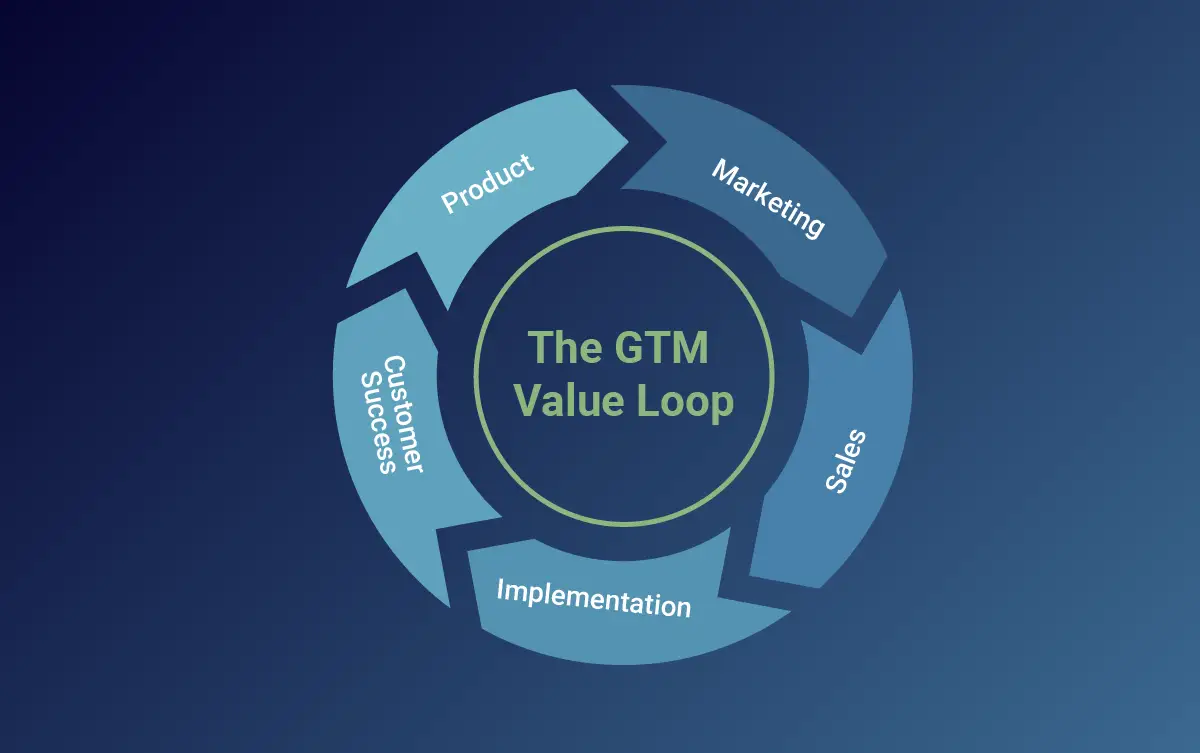
Think of Customer Value as the anchor point. GTM functions form the inner loop, interconnected cycles of Marketing, Sales, Implementation, CS, and Product, while enabling functions like Finance, Operations, HR, Engineering, and Support provide the outer layer of stability. The anchor holds the system steady while the loops keep it moving forward.
What Breaks vs What Works
Here’s how the difference shows up across functions:
- Marketing
When disjointed: messages miss the mark, misaligns pipeline with ICP, overpromises.
When connected: narrative reflects lived outcomes, fueling better win rates, stronger expansion, and credible advocacy. - Sales
When disjointed: leans on discounting or overpromising, signaling unclear or untrusted value.
When connected: ties problem set to solution and value clearly, feeding objections and pricing pressure back into the system.
Result: stronger pricing power and cleaner deals. - Implementation
When disjointed: papers over usability and integration gaps, creating operating debt.
When connected: proves value quickly, publishes friction and time-to-value lessons, resulting in fewer escalations, better references, and tighter playbooks. - Customer Success
When disjointed: inherits strained expectations, stuck in retention firefighting.
When connected: drives adoption, expansion, and advocacy, while sharing leading indicators that raise GRR, NRR, and referrals. - Product
When disjointed: builds features customers don’t value because focused on output, not outcomes.
When connected: prioritizes what drives adoption and outcomes, using field signals to fuel innovation and clearer stories for Marketing and Sales.
And across them all:
- ICP is continuously tested, not static.
- PMF is revalidated, not assumed.
- Incentives align to customer outcomes, not local wins.
The Value Loop: Execution That Learns
A healthy company turns every customer interaction into fuel:
Deliver value → Capture insight → Feed it back → Refine the system
This operating rhythm compounds visibly:
- Better positioning and clearer value stories.
- Smoother implementations and faster time to value.
- Stronger adoption and expansion within the base.
- Advocates who create inputs for future acquisition.
Companies that loop fastest win: startups find and keep product–market fit, scale-ups adapt to shifting markets and sharpen ICP discipline, and mature orgs avoid drift while protecting relevance.
The Compounding Payoff
Operate as a continuum and benefits stack where it matters:
- Customers get clearer value, smoother onboarding, and solutions that evolve with their needs.
- Employees get less friction and more purpose. Time shifts from rework to progress.
- Leaders get efficient growth: survival in startup mode, acceleration in scale-up mode, profitability in maturity.
The payoff is both cultural and financial. When every team sees itself as responsible for customer value, silos fade, trust rises, and the system generates its own momentum unlocking both new and expansion growth that compounds more predictably.
Closing Thought
Success comes from ensuring customer value stays the anchor point and the Value Loop keeps turning so every motion compounds into sustained growth. Driving that system mentality and discipline is the CEO’s responsibility. The conviction and direction they provide make the difference between growth that leaks and growth that endures.